Inside the Gulf’s $100 Billion-Plus AI Infrastructure Race — and What It Means for Regional Business
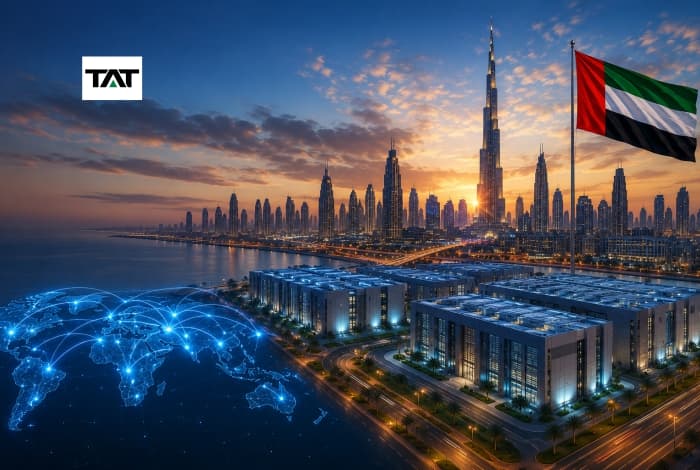
“The UAE and Saudi Arabia are each building sovereign AI infrastructure at a scale few nations can match. Here’s what the buildout actually consists of, and why it matters for every business operating in the region.”
There is a version of the “Gulf goes big on AI” story that treats it as an extension of familiar Gulf sovereign wealth behavior — big numbers, prestige projects, headlines. The more accurate read is that the UAE and Saudi Arabia are attempting something structurally different: building the physical infrastructure layer of the global AI economy inside their own borders, at a scale that puts them in direct competition with the United States and China for a role most analysts assumed would remain a two-country contest.
Key Takeaways
• The UAE’s Stargate project is building a 1-gigawatt AI compute cluster backed by G42, OpenAI, Oracle, Cisco, NVIDIA, and SoftBank, part of a broader 5-gigawatt UAE-US AI campus now under construction. • Saudi Arabia has advanced a $10 billion PIF-Google Cloud partnership for a global AI hub, alongside HUMAIN’s own 500-megawatt AI factory build-out powered by hundreds of thousands of NVIDIA GPUs. • Both countries’ combined sovereign wealth exceeds $3 trillion, and both now have access to advanced U.S. AI chips following the lifting of export restrictions — positioning the Gulf as a genuine third pole in global AI infrastructure, alongside the U.S. and China.
The UAE’s 5-Gigawatt AI Ambition
The UAE’s flagship effort is Stargate — a 1-gigawatt AI compute cluster backed by G42 alongside OpenAI, Oracle, Cisco, NVIDIA, and SoftBank, part of a larger 5-gigawatt UAE-US AI campus that is now under construction, with early infrastructure already coming online. Officials involved in the project have described the ambition in explicitly geopolitical terms: positioning Abu Dhabi-based infrastructure as capable of serving roughly half the world’s population, and framing the buildout as a model for how U.S. AI technology gets deployed to markets that need it most, rather than remaining concentrated solely in the U.S. and a handful of allied markets.
Saudi Arabia’s Multi-Track AI Strategy
Saudi Arabia’s parallel effort runs through several tracks simultaneously. The PIF has advanced a $10 billion partnership with Google Cloud to build a global AI hub inside the Kingdom. Separately, NVIDIA is working directly with the Saudi Data and AI Authority to deploy up to 5,000 Blackwell GPUs for a sovereign AI factory. And HUMAIN — the PIF-backed AI infrastructure company — is building its own AI factories toward a projected 500 megawatts of capacity, powered by several hundred thousand NVIDIA GPUs deployed over five years, with partnerships already in place with xAI and Adobe.
Patient Capital Meets Silicon Access
The capital and policy backdrop makes this buildout more than an ambitious announcement cycle. Combined sovereign wealth across the UAE and Saudi Arabia now exceeds $3 trillion, and both countries gained access to advanced U.S. AI chips after the U.S. Commerce Department lifted export restrictions that had previously frozen billions of dollars of planned infrastructure capital. That combination — essentially unlimited patient capital, plus now-unrestricted access to the hardware needed to build at this scale — is precisely what allows a buildout of this magnitude to move from announcement to construction as quickly as it has.
What It Means for Businesses
For businesses operating in or considering the region, the practical implication goes beyond admiring the scale of these numbers. Infrastructure at this level changes the calculus for where AI-dependent operations should be located, what latency and sovereignty guarantees are realistically achievable regionally, and which partners — G42, HUMAIN, and the broader ecosystem forming around them — are worth engaging now, while the infrastructure is still being built out, rather than after it’s fully operational and partnership terms have hardened. The Gulf’s bet is that being early to build the infrastructure layer creates leverage that being early to use someone else’s infrastructure never could. Whether that bet pays off at the scale being wagered is still an open question — but the infrastructure itself is no longer a projection. It’s under construction now.