The Gulf Is Betting on Nuclear Power to Win the AI Race — While Drones Keep Hitting Its Pipelines
Saudi Arabia signed a landmark nuclear-cooperation deal targeting 17 gigawatts by 2040, and the UAE's Barakah plant already backs its AI data-center buildout. The same week, Houthi drones and missiles keep testing the infrastructure that bet depends on.
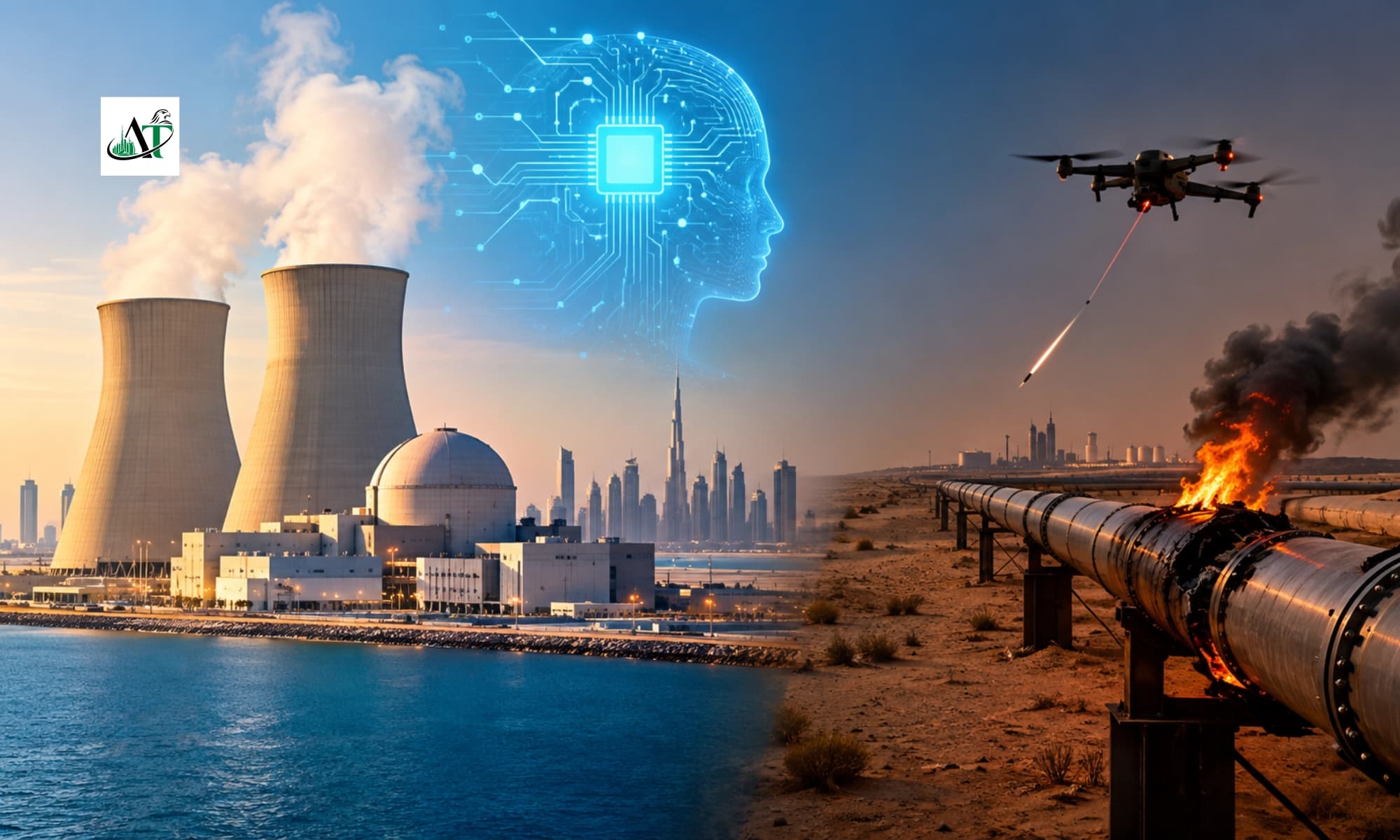
The same week Saudi Arabia's East-West oil pipeline came back online after a Houthi-attributed drone strike forced a ten-day shutdown at the Red Sea port of Yanbu, and Saudi air defenses intercepted fresh missiles and drones aimed at Riyadh and Khamis Mushayt, the region's longer-term energy strategy has been quietly moving toward something that looks a lot steadier: nuclear power. In July, Saudi Arabia and the United States signed a civil nuclear cooperation agreement — the biggest step yet in the kingdom's push toward its first commercial reactor, part of a program now targeting up to 17 gigawatts of nuclear capacity by 2040. Bahrain is exploring small modular reactor technology. And the UAE's Barakah plant, the Arab world's first commercial nuclear facility, already supplies somewhere between a fifth and a quarter of the country's total electricity, with output still climbing as its fourth reactor unit approaches full operation.
The reason nuclear has suddenly become the centerpiece of Gulf energy planning isn't really about carbon targets, even though that's the official language. It's about the same demand curve this coverage has tracked before: Gulf AI infrastructure needs baseload power that doesn't waver, at a scale gas turbines and solar increasingly struggle to guarantee on their own. The hyperscalers building here — Microsoft and G42's Stargate UAE, Saudi Arabia's HUMAIN, Amazon Web Services' $5.3 billion Saudi data-center commitment — carry sustainability commitments that make nuclear's round-the-clock, low-carbon output specifically attractive, not just power in general. Wood Mackenzie's most recent modeling has UAE data-center electricity demand roughly doubling by 2030, and Barakah's stable output is now being marketed directly to the operators building that capacity as exactly the kind of baseload their own emissions targets require.
That's the pitch. The complication is that Gulf nuclear and Gulf AI infrastructure are being financed and built in the same geography, under the same conflict, as the pipelines and cloud facilities that keep getting hit. Saudi Arabia's East-West Pipeline — the alternative export route the kingdom leaned on hard after the Strait of Hormuz effectively closed in February — is oil infrastructure, not nuclear or data-center infrastructure specifically. But it shares the same regional risk profile: the Houthis have already claimed strikes on cloud facilities in the UAE and Bahrain earlier this year, and Iran's Revolutionary Guard claimed a cruise-missile strike on Amazon data-center infrastructure in Bahrain in July. A regulator or hyperscaler signing a decade-long power-purchase agreement, or a government committing capital to a nuclear plant that takes years to build, is making that bet inside an active theater of war — not a stable energy market with occasional geopolitical noise layered on top.
None of this means the nuclear pivot is the wrong call. If anything, it's closer to the right one: a plant like Barakah is a far harder target and a far steadier power source than a single desert pipeline running exposed across 1,200 kilometers. But it does mean the Gulf's AI ambitions now rest on two separate long-horizon bets landing at the same time — that nuclear capacity gets built out fast enough to meet a genuinely explosive demand curve, and that the conflict environment around it stays survivable long enough for that infrastructure to actually get finished. Seven months into a war defined by de-escalation that keeps almost happening and then doesn't, betting on both at once is still probably the most rational option on the table. It just isn't a small bet, and it isn't one the region gets to make twice.