Grid Strain Just Hit 100 Million People in North America. In the Gulf, the Same Collision Is Coming Faster — and Hotter.
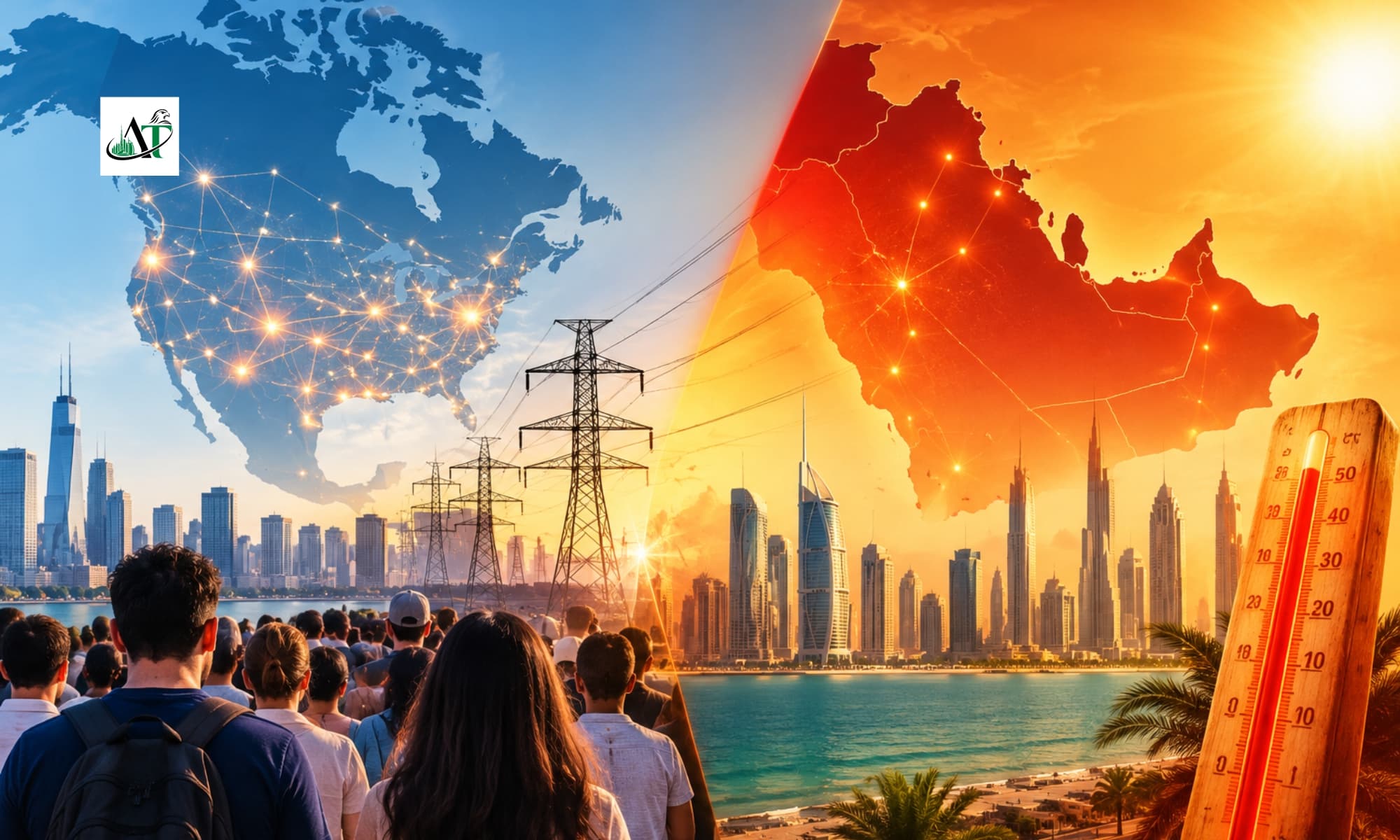
“Unseasonable heat just pushed grids serving 100 million North Americans to their limits. In the Middle East, hotter climates, scarcer water and active conflict make the AI-power collision sharper still — while much of Africa still waits for reliable electricity altogether.”
This week's warning shot came out of North America. Unseasonable heat — more than 20°F above normal in parts of the Midwest, triple-digit temperatures forecast across the South through the weekend — has pushed power systems serving over 100 million people in the US and Canada into a dangerously tight operating window, right as utilities were pulling equipment offline for planned fall maintenance. Grid operators are describing aging infrastructure straining to run flat-out for longer than it was built to, at a moment when reserve margins are already thinner than they used to be. It isn't only a weather story. Analysts tracking the strain keep circling back to the same second cause layered on top of the heat: AI data centers, whose electricity appetite has become large enough to reshape regional power markets on its own.
The Physics of Gulf Cooling Under Extreme Heat
That collision — extreme heat plus AI-driven demand growth outpacing what the grid was designed for — is a preview of a fight that's already further along in the Gulf, and the physics there are considerably less forgiving. Ambient summer temperatures in the region regularly exceed 45°C, and the Gulf sits inside a broader Middle East and North Africa zone that contains eleven of the world's seventeen most water-stressed countries. That combination turns data-center cooling, which is a manageable engineering problem in a temperate climate, into one of the defining constraints on how fast AI infrastructure can actually scale here. Saudi Arabia draws roughly 70% of its drinking water from desalination — itself one of the most electricity-intensive processes there is — which means a summer power crunch and a summer water crunch are, in the kingdom, functionally the same event.
Gigawatt Ambitions and Regulatory Friction
And the scale of what's being built into that constraint is enormous. Saudi Arabia's data-center capacity has grown from 68 megawatts in 2021 to more than 440 megawatts today, with HUMAIN, the PIF-backed AI company, targeting roughly 6 gigawatts by 2034 on an estimated $77 billion in financing. In Abu Dhabi, Stargate UAE — the G42, OpenAI, Oracle, SoftBank, Nvidia and Cisco venture — is building toward a 5-gigawatt campus, with its first 200-megawatt phase due online this quarter. Wood Mackenzie projects UAE data-center power demand will simply double by 2030. Regulatory gaps are part of the story too: despite the UAE's own target of sourcing close to a third of its power from clean energy by 2030, current rules mostly block data-center operators from signing direct renewable power-purchase agreements, leaving gas turbines to carry the bulk of the load anyway.
Physical Infrastructure as a Military Target
There's a dimension to this region's power story that the North American grid-strain narrative doesn't have to reckon with at all: the infrastructure itself has become a military target. The OECD warned in June that a prolonged Middle East conflict and continued restriction through the Strait of Hormuz could delay or halt Gulf AI ambitions outright, citing March 2026 drone strikes on cloud facilities in the UAE and Bahrain and naming Saudi Arabia's $2.7 billion Hexagon facility among the assets at risk. On July 21, Iran's Revolutionary Guard claimed cruise-missile strikes on Amazon data-center infrastructure in Bahrain. Power and compute in this region aren't just scarce — in 2026, they're being actively fought over.
The Continental Divide: Power Decides the Winner
Set that against the rest of the continent this coverage is meant to include, and the contrast gets stark fast. While Gulf states commit tens of billions of dollars to gigawatt-scale AI campuses, roughly half of Sub-Saharan Africa still has no reliable connection to a power grid at all, and this year's regional energy-price shock pushed South Sudan's capital, Juba, into outright electricity rationing. The same twelve months in which the Gulf is racing to become a global AI compute hub are the twelve months in which large parts of the continent are being asked, again, to compete for digital-economy investment without dependable electricity to run it on. Power, not chips and not capital, is the real bottleneck deciding who actually wins the AI race across this region — and in the Middle East and Africa specifically, that bottleneck runs straight through hotter grids, scarcer water, and, in places, active conflict zones.