The Map-Maker Who Builds the Road While He Walks It
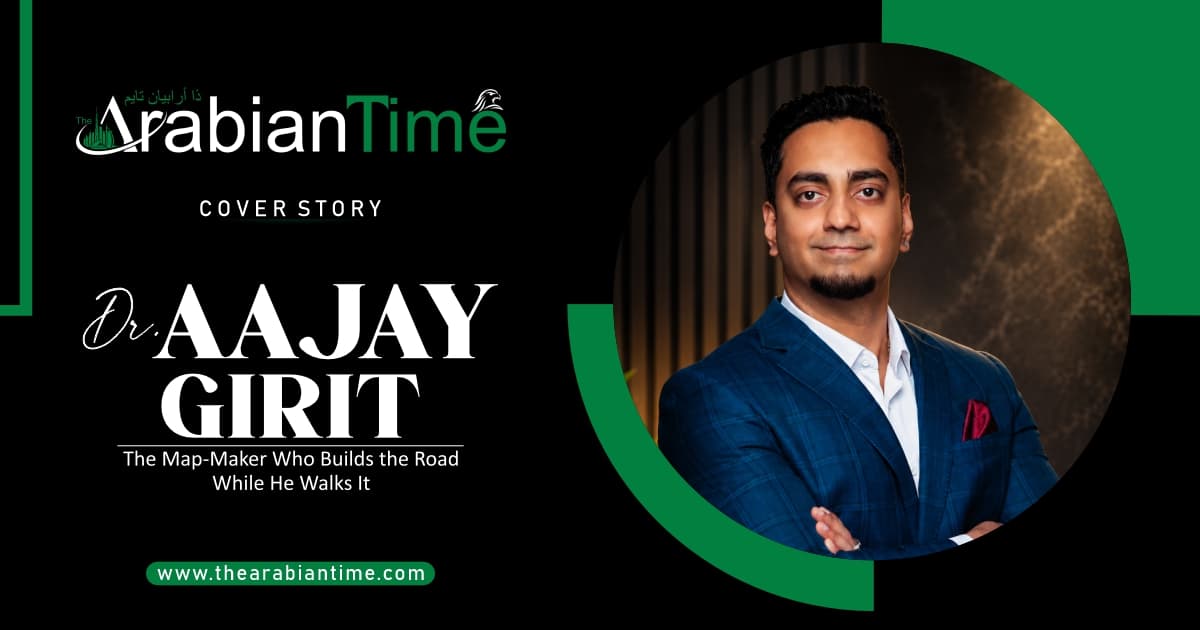
“Dr. Aajay Girit, Chief Marketing Officer at Thawani Pay, is a visionary marketing and digital transformation leader redefining corporate communication and consumer trust in the Gulf & APAC regions.”
There is a particular kind of mind that cannot settle. Not because it is distracted or restless in the ordinary sense, but because it genuinely finds the present state of any system - a market, a team, a campaign, or an institution - less interesting than what that system could become. Dr. Aajay Girit is that kind of mind. Across nearly two decades spent moving between the programmatic advertising environment of Southeast Asia and the regulated financial corridors of the Gulf, that quality has not just shaped his career; it has defined it.
He is, on paper, a highly credentialed marketing and digital transformation leader in the Gulf region: a Doctor of Business Administration in Marketing from Monash University, an MBA in Marketing from the University of Derby, and the Fellow Chartered Marketer (FCIM) designation from CIM | The Chartered Institute of Marketing. His professional journey spans IPG Mediabrands, ADCB, Al Masraf, and now Thawani Pay, supported by a career built across Southeast Asia and the Gulf. But credentials do not explain the career, and the career does not fully explain the man. What does is something harder to quantify: a refusal to understand marketing as anything less than the full architecture of how a business earns trust and converts it into growth.
He will tell you, if you ask, that marketing is where psychology meets data and strategy meets storytelling. But what becomes clear across a conversation with him is that this is not a description he has rehearsed. It is how he actually thinks. Every question about a specific campaign or a specific market eventually reveals itself as a question about something deeper about what a customer is really trying to achieve, about what an institution is actually afraid of, and about how the distance between those two realities can be closed.
That is the project that has kept him moving. Not from job to job, but from challenge to challenge. And he is far from done.
The Beginning: Curiosity Before Ambition
It would be tempting to trace Dr. Aajay Girit's career back to a single galvanising moment - the kind of origin story that makes retrospective sense of everything that followed. The truth, as he tells it, is both more honest and more instructive. His path into marketing began not with ambition but with curiosity.
He was fascinated, from early on, by the mechanics of human decision-making. Why do people trust certain brands and not others? Why does one message land and another bounce off entirely? Why do two businesses operating in the same product category grow at dramatically different rates? These were not idle questions. They were, for him, the essential questions - the ones that marketing, if practiced with enough rigour and enough imagination, was uniquely positioned to answer.
The moment that sharpened that curiosity into conviction came in the early years of performance and programmatic advertising in Southeast Asia. What he saw there, in markets still working out what digital media could actually do, was that marketing was undergoing a structural transformation. The discipline was moving, irreversibly, away from intuition toward evidence. Campaigns could now be measured. Audiences could be understood. Optimization could be automated. Impact could be proved. And for someone who had always believed that marketing should be held to the same standard of accountability as any other business function, that shift felt less like a technological development and more like a philosophical vindication.
He entered the profession as a student of why people behave the way they do. He has remained, across every market and every sector he has navigated since, a practitioner who measures the value of that understanding not by how interesting it is, but by what it actually produces for the business and the customer it serves.
The Discipline of Depth: On Academic Rigour and Real-World Speed
Few senior marketing executives have invested as deliberately as Dr. Aajay Girit in the formal, academic dimensions of their craft. His MBA, his Fellow Chartered Marketer (FCIM) designation from CIM | The Chartered Institute of Marketing, and his Doctor of Business Administration in Marketing are not decorative achievements appended to a career built elsewhere. They are the evidence of a specific and considered belief: that experience teaches you speed, but academic rigour teaches you depth, and that both are necessary for the kind of leadership that actually moves organisations forward.
In practice, this translates into a distinctive way of asking questions. Before any campaign, any initiative, any transformation programme, the first instinct is not to act but to interrogate. What is the customer problem being solved? What behaviour needs to change? What data supports the underlying assumption? What is the anticipated contribution to acquisition, activation, retention, revenue, or brand equity? These are not questions that slow execution. They are the questions that prevent organisations from executing brilliantly on the wrong problem.
His teams will tell you - and several have - that working under him is an exercise in being expected to think before you build. The quality of the question, in his framework, is the primary determinant of the quality of the outcome. That is not a philosophy he teaches. It is a standard he holds, consistently and without apology.
The balance this creates in his leadership is something that does not always get named clearly in conversations about marketing leadership, but which his career illustrates with unusual clarity: he respects creativity, but he requires structure. He values speed, but not at the cost of strategic clarity. He believes deeply that art and science are not opposites in marketing; they are complements, and the failure to develop fluency in both is one of the primary reasons so many marketing functions underperform their potential.
The Gulf's Financial Corridors: Marketing Where Trust Is the Product
The CMO role inside a regulated financial institution is, in most respects, a different profession from what the title suggests in other industries. It is not primarily about brand campaigns or customer acquisition strategies, though both matter. It is about trust, governance, accountability, and the long-term relationship between an institution and the customers who have chosen to place their financial lives in its hands. Dr. Aajay Girit has built that understanding across leading financial institutions in the region, including ADCB and Al Masraf, and now within the fintech environment at Thawani Pay.
In financial services, he will tell you, customers are not making a purchase in the conventional sense. They are making a trust decision - entrusting an institution with their money, their identity, their financial future, and in many cases, their family's security. That is an extraordinary thing to ask of another person or organisation. And every message, every campaign, every digital initiative, every customer journey must be designed in the full awareness of what that trust actually means. Breach it, even inadvertently, even in a single poorly considered communication, and the cost is disproportionate to the mistake.
This is why the CMO in a traditional financial institution must work, credibly and continuously, across compliance, risk, legal, technology, product, and business teams. Not to slow innovation - a framing he rejects firmly - but to make innovation sustainable. To ensure that bold ideas are also trusted ideas. To create the conditions in which an organisation can move faster without undermining the credibility that makes its speed meaningful.
His approach to that challenge, refined across multiple institutions and market environments, is built on a deceptively simple principle: be ambitious in vision, disciplined in execution, and transparent in stakeholder communication. Applied consistently, that combination builds the institutional momentum that allows genuine transformation to happen - not as disruption for its own sake, but as an evolution that the organisation and its customers can trust.
Southeast Asia to the Gulf: Building Belief in a New Way of Marketing
Before the Gulf, before the financial institutions, before the Doctorate and the regional leadership profile, there were the early years in Southeast Asia - Malaysia, the Philippines, and markets where programmatic advertising was still a concept more than a practice, and where the primary job of someone working in that space was not selling media but building belief.
The distinction matters more than it might appear. In markets where a new technology or a new discipline is still finding its footing, the commercial challenge is never primarily technical. It is educational and relational. Clients who understood digital media perfectly well often had no framework for thinking about audience buying, data segments, real-time bidding, attribution, or automated optimization. Introducing those concepts required something more demanding than a sales pitch: it required the patience to sit with a client's uncertainty and the skill to translate complex technical realities into business value they could feel.
That experience left him with three convictions he carries into every new context. Technology, no matter how sophisticated, only works when the people using it understand the value it creates. Education is an inseparable part of transformation: adoption without clarity is adoption that fails. And data must serve strategy; it can inform, accelerate, and validate strategic thinking, but it cannot replace it.
The third lesson came from the nature of programmatic itself, which is fundamentally an experimental discipline. Campaigns are tested, results are measured, hypotheses are refined, and improvements are made. What he took from that operating rhythm was not a set of techniques but a mindset: that in fast-moving markets, the competitive advantage belongs not to those with the most certainty but to those with the most systematic approach to learning from uncertainty. That mindset has stayed with him across every sector he has entered since, as applicable to a regulated financial-services transformation programme as it was to a real-time bidding campaign in Kuala Lumpur.
AI, the CMO, and the Intelligence Architecture of Modern Marketing
The conversation around artificial intelligence in marketing is, at this point, almost unavoidably noisy. The claims are large, the timelines are contested, and the gap between what is technically possible and what is practically deployable in a real organisation remains significant. Dr. Aajay Girit has been watching this conversation develop for several years from the position of someone who has operated at the intersection of data, technology, and marketing strategy long enough to distinguish between what genuinely changes the game and what only changes the vocabulary.
His view, stated plainly, is this: AI is shifting the CMO role from campaign leadership to intelligence leadership. It is making marketing faster, more predictive, and more personalised across segmentation, content generation, campaign optimisation, customer service, media buying, journey analytics, and decision-making. But the real opportunity is not using AI to produce more content or more campaigns. The real opportunity is using AI to make marketing more relevant, more efficient, and more genuinely accountable than it has ever been able to be before.
The prerequisite for that opportunity, he is careful to note, is infrastructure that many organisations have not yet fully built. Clean data. Proper tagging. CRM discipline. Customer segmentation. Consent management. Analytics frameworks. Clear use cases. Without these, AI becomes, in his phrase, a tool without direction - capable of producing outputs at scale, but outputs that are not anchored to a strategy or measurable against a meaningful objective.
For marketing teams, the required development is equally specific. Prompt engineering. Automation workflows. AI-assisted creativity. Performance analytics. Ethical data use. These are not supplementary skills for the digital native on the team. They are the baseline literacy for every marketer who intends to remain relevant in the next five years. And for CMOs, the responsibility is to build the frameworks and the cultures in which that literacy can be developed and applied with the judgment and the purpose that AI, however capable, cannot provide for itself.
The Gulf: Where Digital Sophistication Meets Cultural Complexity
The Gulf is, by almost any measure, one of the most demanding marketing environments in the world. It is technically sophisticated in ways that challenge even well-resourced global organisations. Its consumers are digitally confident, mobile-first, and exposed to high global standards of service and product experience. And it is, at the same time, a market where cultural values around trust, relationships, reputation, family, language, and community are not background considerations to be accommodated but foreground realities to be built around.
Working across these two realities simultaneously, without compromising either, is the essential challenge of marketing in the Gulf. Dr. Aajay Girit has spent years developing the instincts required to do it well, and his articulation of what that requires is worth sitting with. Relevance, he argues, is not simply a function of data and personalisation, though both matter. It is equally a function of cultural understanding - the ability to sense, accurately and with genuine respect, what a message needs to feel like for the audience receiving it to trust it.
A message may be technically correct and still fail to land, not because the data was wrong or the targeting was off, but because the emotional register was disconnected from the audience's reality. That kind of failure is more expensive than a poorly executed campaign, because it erodes something that data cannot rebuild: the credibility of the brand in the eyes of the people it is trying to serve.
In financial services specifically, where the Gulf market has particular depth and particular complexity, the balance he has learned to strike between aspiration and credibility. Customers in this region want to see innovation. They want digital convenience, seamless experiences, and the sense that the institution they have chosen is building for their future. But they also need to feel secure. They need assurance. And the marketing that succeeds in this environment is the marketing that can hold both needs - ambition and reassurance, innovation and trust - in the same communication, credibly and without apparent effort.
The Full Funnel, the Boardroom, and the Language of Business Growth
One of the persistent failures of marketing as an organisational function has been the inability or unwillingness to speak the language of the boardroom with the same fluency that a CFO or a COO can. Dr. Aajay Girit has made the development of that fluency a defining feature of his leadership, and his thinking on why it matters and how it is achieved deserves more attention than it typically receives.
Marketing budgets are under greater scrutiny than at almost any point in recent memory. The expectation that CMOs can demonstrate ROI with the rigour of a financial analyst is now effectively the minimum bar for leadership credibility at the executive level. Impressions, clicks, and engagement rates are not the language of that conversation. Revenue, customer acquisition cost, activation rate, lifetime value, payback period, and long-term brand equity are.
His approach is to build the measurement framework before the execution begins to define, at the outset, what success means in business terms and how it will be tracked. That discipline produces two outcomes that are both valuable. It makes marketing accountable to the business in ways that build trust with leadership and with finance functions. And it creates a feedback loop that makes campaigns progressively smarter, because teams know what they are optimising for and can measure whether they are getting there.
The brand and performance question, which so many organisations frame as a tension to be managed, is one he reframes entirely. He does not see them as competing priorities. He sees them as two sides of the same growth system: brand builds the trust and preference that make performance possible, while performance converts that trust into measurable action that justifies brand investment. The organisations that artificially separate the two end up with brand work that cannot be defended commercially and performance marketing that grows increasingly expensive as the brand it relies on prioritizes.
The strongest marketing organisations, he argues, are those that have built a full-funnel discipline: a deep understanding of how awareness becomes consideration, how consideration becomes action, and how action becomes loyalty. That understanding is what makes growth sustainable rather than dependent on the next campaign.
On Building People: The Philosophy Behind the Team
Ask Dr. Aajay Girit what he is most proud of across a career that spans continents and industries, and the answer is not a campaign or a transformation programme or a market entry strategy, though he has achievements in all of those categories. The answer is people. Specifically, the people he has helped to become more than they were when he found them.
His philosophy of team development is summarised in a phrase he uses with genuine conviction: build people, not only departments. A strong marketing function, in his framework, is not created by assembling technical specialists. It is created by developing people who can think, collaborate, take ownership, and grow alongside the business they are serving. Technical skills are the entry requirement. Curiosity, accountability, resilience, humility, and learning agility are the qualities that determine who a person can become.
He looks for marketers who can connect creativity with business thinking. Who understand the customer deeply but can also hold a conversation about revenue, cost, conversion, retention, and operational impact without losing the thread. Who can move between the emotional register of a brand narrative and the analytical rigour of a performance review without either one contaminating the other.
In developing those qualities, he has learned to trust a method that most managers resist: giving people ownership before they feel completely ready. Not abandoning them, and not leaving them unsupported, but putting them in situations that are slightly beyond their current comfort level and watching what happens. The result, consistently, is the development of confidence and judgment that no structured training programme can replicate. It comes from real decisions, real consequences, and the experience of being trusted when the stakes are genuine.
Southeast Asia Versus the Gulf: Two Markets, One Discipline
The comparison between Southeast Asia and the Gulf as marketing environments is one that Dr. Aajay Girit is unusually well positioned to make, having built significant careers in both. His observations are sharp and practically useful in ways that go beyond the obvious differences in geography and culture.
Southeast Asia is defined by extraordinary diversity in language, in infrastructure, in payment behaviour, in media consumption, in market maturity, and in the price sensitivities of consumers. A strategy that performs well in Malaysia may not transfer to the Philippines. What works in Singapore may need to be redesigned almost entirely for Indonesia or Thailand. The region offers scale, but scale that is fractured across dimensions that cannot be glossed over without real cost to performance. Growth in Southeast Asia requires localization at scale the ability to adapt rapidly and meaningfully across contexts that are superficially similar but operationally distinct.
The Gulf presents a different set of challenges. Digital adoption is high. Infrastructure is strong. Consumer expectations are sophisticated. But the cultural dimension - the importance of trust, relationship, language, and credibility in a region where financial services and communication both carry significant social weight - demands a precision that data alone cannot deliver. In the Gulf, the question is not just whether the campaign is targeted correctly. It is whether the brand has earned the right to be heard by the audience it is trying to reach.
The unifying principle across both regions, in his view, is customer relevance. Local understanding is not a supplementary consideration to be added after the strategy is built. It is part of the foundation. Digital growth that is designed without genuine knowledge of the market it is entering will always underperform not because the technology is wrong, but because the insight is absent.
Recognition and the Responsibility That Follows It
Professional recognition, especially from platforms connected to technology, innovation, and leadership, is the kind of milestone that reveals character as much as it marks achievement. Dr. Aajay Girit's response to it is, in that sense, telling. His first instinct is not to catalogue what recognition represents, but to articulate what it requires of him going forward.
Recognition, in his framework, is a reminder of responsibility. When a platform connected to technology, innovation, and leadership holds you up as a reference point, it reflects not just past performance but future expectation. It says, implicitly: this is the standard. Continue to uphold it. He takes that seriously not as a burden but as a commitment to continue learning, sharing, and contributing at the level the recognition implies.
What strikes him most is the way recognition can disconnect a leader from the collaborative reality that made the achievement possible in the first place. Every milestone is built by more than one person. Every transformation programme is the product of a team's collective intelligence, effort, and willingness to keep going when the path is unclear. Every career is shaped by mentors, colleagues, organisations, and opportunities that rarely appear in award citations. He is deliberate about naming that reality not out of false modesty, but out of genuine conviction that leadership recognition only produces value when it is converted back into investment in others.
For the next generation of marketing and technology professionals - particularly those navigating careers across digital marketing, fintech, AI, analytics, and customer experience - that conversion is the most meaningful thing he can offer. Not the recognition itself, but the thinking, the experience, and the hard-won clarity that made it possible.
The Vision: What the Next CMO Must Become
When Dr. Aajay Girit describes the future of marketing leadership, he is not describing a role that looks like today's CMO with better technology. He is describing a fundamentally different kind of leader — one who holds brand, data, technology, customer experience, revenue, partnerships, AI, and organisational change not as separate competencies to be managed by separate teams, but as an integrated operating system for business growth.
The future CMO, in his vision, is an intelligence leader as much as a communications leader. Someone who can look at an organisation's customer data and see not just what is happening but what should happen next. Who can look at an AI deployment and assess not just its efficiency but its strategic fit, its ethical implications, and its long-term contribution to the customer relationship. Who can walk into a boardroom and speak about marketing's contribution to business growth with the same precision and credibility as the CFO speaking about financial performance.
In the Gulf and across APAC, that vision takes on a specific shape. The opportunity is to build marketing models that are globally competitive but locally relevant: models that use data, automation, and AI to create better customer experiences without sacrificing the cultural intelligence and the trust that those markets specifically demand. It is one of the most interesting leadership challenges in the world right now. It requires exactly the combination of disciplines that Dr. Aajay Girit has spent nearly two decades developing.
At Thawani Pay, that vision finds a particularly meaningful context. Fintech has the capacity to improve daily life in ways that traditional financial services rarely could: supporting merchants, increasing financial accessibility, contributing to national digital transformation agendas, and building the kind of trusted digital ecosystems that make a real difference to the people who use them. To help build that, and to help lead it, is not simply a career goal. It is a purpose.