Inside Emirates' Comfort Arms Race: What a Single Headrest Reveals About a $50 Billion Strategy
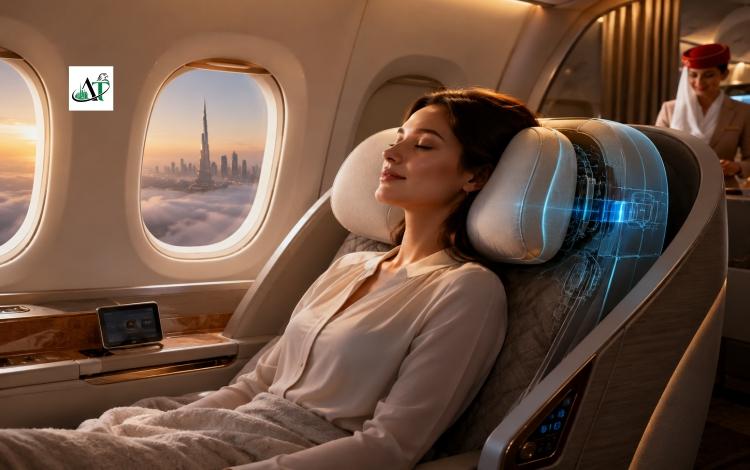
“Emirates' new fleet-wide economy headrest is one visible piece of a much larger, multi-front campaign to win premium and economy passengers alike in an increasingly crowded Gulf aviation market.”
Emirates' new fleet-wide economy headrest is one visible piece of a much larger, multi-front campaign to win premium and economy passengers alike in an increasingly crowded Gulf aviation market — one where Qatar Airways has deliberately chosen not to compete.
Key Takeaways
• Emirates' U-Dream headrest, unveiled July 20, 2026, is deploying fleet-wide across A350s, most A380s, 777s, and all 270 Boeing 777X aircraft on order — not a limited trial. • The headrest launch is one piece of a broader cabin investment strategy that includes Premium Economy expansion to new routes (Dubai–Beirut from January 2026, Dubai–Beijing from February) using retrofitted Boeing 777s. • Qatar Airways, Emirates' closest regional rival, has explicitly chosen not to offer Premium Economy at all, betting instead on its Qsuite Business Class and extra-legroom Economy — leaving Emirates as the only major Gulf carrier competing across all three cabin tiers on many routes. • IATA data shows global premium air travel grew 11.8% in 2024, slightly outpacing economy class growth at 11.5% — the underlying demand trend that makes this entire multi-front investment strategy commercially rational.
A Small Product With a Large Strategic Footprint
A headrest is, on its face, a minor product update — the kind of incremental comfort tweak most airlines announce and move past within a news cycle. Emirates' version, the U-Dream headrest unveiled July 20, 2026, deserves a longer look precisely because of the scale of its rollout. Deployment covers every Emirates A350 in the fleet, most existing A380s and 777s, and — critically — all 270 Boeing 777X aircraft the airline has on order will arrive with the unit pre-installed from the factory. Supplied through Safran Seats' established Z400 economy seat system rather than a bespoke design, the headrest is expected across every Emirates A350 by the end of 2026. That is a fleet-wide commitment made before the product has had even a full year of real-world passenger feedback — a decision that only makes sense if it's one piece of a larger, already-committed strategy rather than a standalone experiment.
The Larger Campaign the Headrest Sits Inside
Zoom out, and the headrest is one visible data point inside a considerably larger cabin investment campaign Emirates has underway simultaneously across every class of service. On the premium side, Emirates is expanding Premium Economy — the cabin tier between standard Economy and Business Class — onto new long-haul routes, with retrofitted Boeing 777s introducing the cabin on Dubai–Beirut flights from January 2026 and Dubai–Beijing from February, making Beijing the fourth mainland Chinese city to receive the product. These same retrofitted aircraft simultaneously introduce Emirates' latest 1-2-1 Business Class configuration, meaning a single fleet upgrade program is touching three cabin classes at once.
The competitive backdrop makes Emirates' specific choices more interesting than they'd appear in isolation. Qatar Airways — widely regarded as Emirates' closest regional rival, and the operator of the industry-influential, fully-enclosed Qsuite Business Class — has taken the opposite strategic position on Premium Economy, opting instead to invest in extra-legroom Economy and its Qsuite product, and has been notably slower to introduce a dedicated Premium Economy cabin across its fleet. That's not an oversight; Qatar has said publicly it sees no strategic place for the cabin tier. Turkish Airlines, a major competitor on both the Beirut and Beijing routes via Istanbul, doesn't currently offer true Premium Economy either. The practical result: on several of the specific long-haul routes where Emirates is deploying its retrofitted aircraft, it is currently the only major carrier offering a genuine middle-tier cabin option — a real, if potentially temporary, competitive gap in the market.
Where the Headrest Fits in Emirates' Economy Strategy Specifically
On the economy side specifically — where the U-Dream headrest lives — Emirates has built a separate reputation advantage through its A380 fleet, whose two-deck structure enables higher-capacity layouts while still offering more open cabin space than typical single-aisle configurations, and Emirates is widely recognized as a leader in what's been termed the 'Economy Class Revolution' of wider seats, improved legroom, and ergonomic redesigns aimed specifically at long-haul flights of eight to sixteen hours. Independent seat-comfort rankings in 2026 have placed both Qatar Airways and Emirates among the world's most spacious economy cabins — meaning the headrest launch reinforces an existing area of strength rather than compensating for a weakness.
Why This Is Happening Now
The underlying demand data explains why Emirates and its Gulf rivals are collectively investing this heavily across every cabin tier simultaneously. IATA figures show global premium air travel grew 11.8% in 2024, modestly outpacing economy class growth of 11.5% — and in most major regions, including the Middle East, premium growth has consistently outpaced economy expansion, signaling a sustained shift toward higher-value air travel. Gulf carriers specifically account for a 14.7% share of global premium passengers, a concentration that explains why Emirates, Qatar Airways, Etihad, and newer entrants like Riyadh Air are all investing heavily and simultaneously — the region has more at stake in winning premium travelers than almost anywhere else in the world.
What the Headrest Actually Signals
Read against this backdrop, Emirates' economy headrest stops looking like a minor comfort update and starts looking like what it actually is: one deliberately chosen, fleet-wide investment inside a much larger, multi-cabin, multi-route campaign to win passengers across every price point simultaneously, at a moment when the entire Gulf aviation sector has identified premium and long-haul comfort as the defining competitive battleground of 2026. Whether Emirates' specific bet — competing hard across all three cabin tiers, rather than concentrating on one like Qatar has chosen to do — proves the more durable strategy will be one of the more instructive competitive tests in global aviation over the next two to three years.